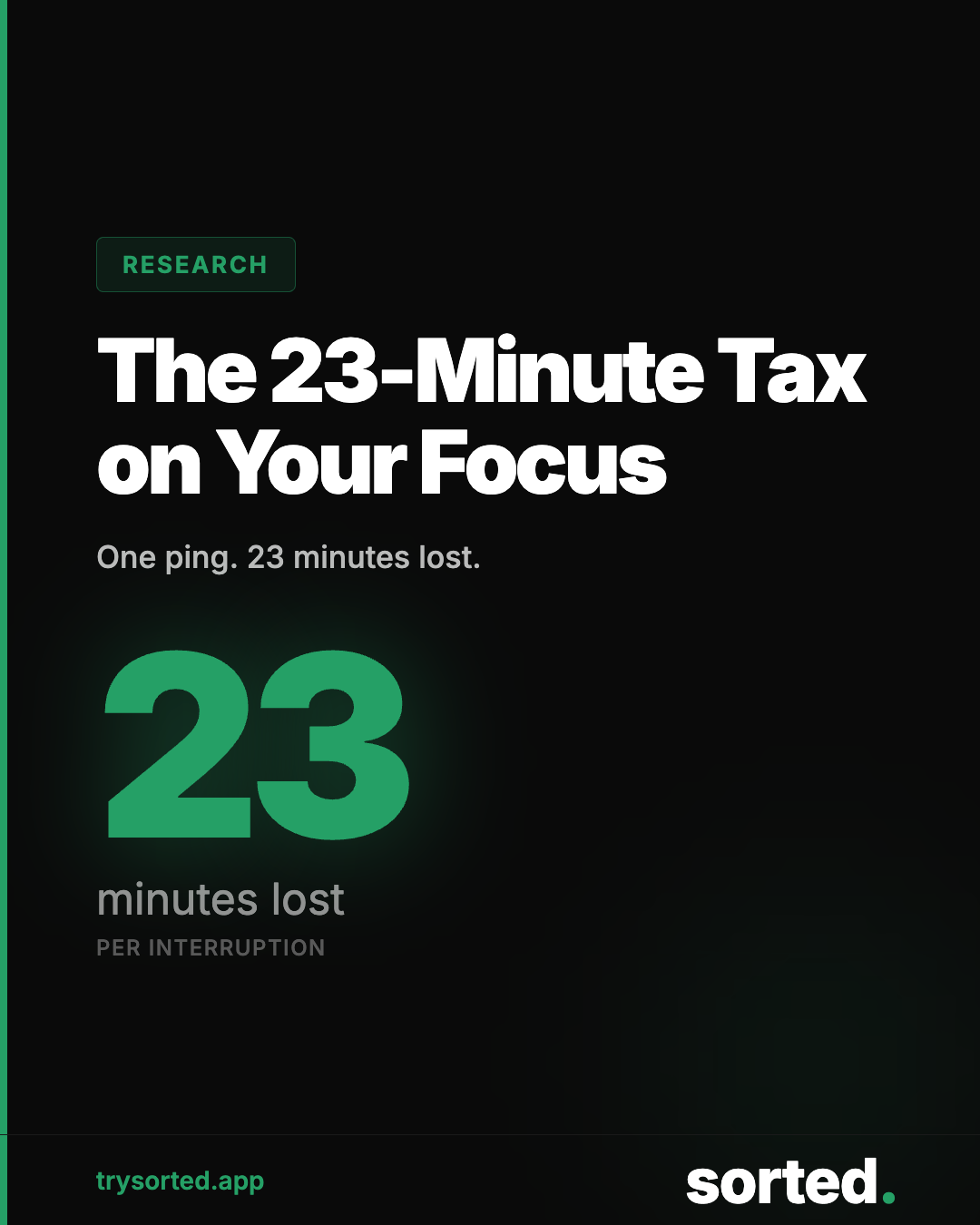
Here is a number worth sitting with: 23 minutes and 15 seconds.
That is how long it takes the average knowledge worker to return to full focus after a single interruption, according to research by Dr. Gloria Mark and her team at the University of California, Irvine.
Think about what that means in a workday where you receive 121 emails.
The Research Behind the Number
Dr. Mark's work on workplace interruptions began in the early 2000s with direct observation studies. Her research team followed knowledge workers throughout their workdays, tracking every task switch, interruption, and period of sustained focus.
What they found challenged the common assumption that interruptions are minor inconveniences. The 2008 CHI paper, "The cost of interrupted work: More speed and stress," co-authored with Daniela Gudith and Ulrich Klocke, documented not just the attention recovery time but a secondary effect: workers who are frequently interrupted adapt by working faster, but they report higher stress, frustration, and cognitive load as a result.
In other words, your brain compensates for the cost of interruptions by accelerating, but the compensation itself is costly. Speed replaces depth, and stress accumulates.
"Workers who are frequently interrupted adapt by working faster — but at the cost of higher stress, frustration, and cognitive load."— Mark, Gudith & Klocke, UC Irvine, 2008
How Email Creates an Interruption Trap
Email is a particularly effective interruption mechanism for several reasons that are worth understanding.
Unpredictable arrival
Email arrives on an irregular schedule. This is significant because research on conditioning shows that irregular reward schedules produce the most persistent checking behavior.[2] Checking email is rewarded occasionally, which is more behaviorally compelling than consistent or never. The unpredictability itself drives the checking habit.
Notification design
Most email clients, by default, are configured to display notifications for each arriving message. A notification is designed to redirect attention. Even if you do not act on it, the visual or auditory signal of a new message interrupts working memory. The attention cost begins the moment the notification appears, not when you click it.
A 2016 study published in the Journal of Experimental Psychology found that receiving a notification, even without checking it, impaired performance on tasks requiring sustained attention to the same degree as actually using a phone.[3]
Context switching penalty
Research on task switching consistently finds that shifting attention between different types of work carries a cognitive penalty beyond simple time lost. Switching from deep analytical work to reading and processing email requires the brain to reconfigure the context it is maintaining: what you are working on, where you are in the process, what decisions are pending. Rebuilding that context after the interruption takes time and effort that does not appear in any productivity metric.
The Compounding Math
Let's apply the 23-minute recovery figure to a realistic workday.
If you check email six times between scheduled sessions, and each check counts as one interruption, you have potentially allocated 2.3 hours of your day to attention recovery alone. Add the actual time spent reading and responding, and you have consumed most of a productive morning.
Most professionals do not check email six times between sessions. They check it continuously. Dr. Mark's more recent research, published in a 2012 study titled "No Task Left Behind?", found that workers average a task switch every three minutes and five seconds when at their desks.
What the Mitigation Research Shows
The University of British Columbia study by Kushlev and Dunn tested a simple intervention: what happens if you restrict email checks to a maximum of three times per day?
Participants who limited their email sessions reported significantly lower stress and no meaningful reduction in feeling on top of things or missing important messages.[5] The fear that reducing email frequency would cause problems was not borne out in practice.
Cal Newport's work on deep work, drawing on the cognitive science literature, argues that the capacity for sustained focus is both valuable and trainable, but it degrades when subjected to constant fragmentation.[6] Protecting focused time from email interruptions is not a luxury preference. It is a skill maintenance requirement for knowledge workers.
Practical Implications
The research points toward several practical conclusions.
Turn off email notifications. The notification itself carries an attention cost independent of whether you act on it. Removing the notification removes the trigger.
Designate email sessions. Two or three windows per day covers most professional contexts while protecting focused work time. Schedule them when focus is naturally lower: mid-morning, after lunch, end of day.
Automate the sorting. If your inbox is pre-sorted when you sit down to your email session, the session itself is shorter and more focused. You are reading and responding, not triaging. That distinction matters for how long the session takes and how cognitively taxing it is.
The goal is not to be less responsive. It is to make your actual hours of focused work productive enough that the time you spend on email, when you do spend it, is worth it.
Frequently Asked Questions
Does it really take 23 minutes to refocus after every email?
Dr. Gloria Mark's research at UC Irvine found an average of 23 minutes and 15 seconds to return to full focus after an interruption. This is an average across task types and interruption contexts. Some interruptions cost less recovery time; some cost more. The key finding is that the cost is substantial and consistent.
Does turning off email notifications actually help productivity?
Research published in the Journal of Experimental Psychology (Stothart et al., 2015) found that receiving a notification, even without checking the device, impaired attention on sustained focus tasks. Removing notifications removes the trigger that initiates the interruption.
How many times per day should you check email?
Research from the University of British Columbia found that three designated email sessions per day significantly reduced stress without participants reporting a meaningful sense of missing important information. The specific number matters less than switching from continuous monitoring to scheduled sessions.
Is email interruption worse than other kinds of interruptions?
Email is one of the most common sources of workplace interruption, and the notification design of most email clients is optimized to capture attention. The cognitive cost of an email interruption is similar to other task switches, but email's frequency makes its cumulative impact disproportionate.
Sources
- Mark, G., Gudith, D., and Klocke, U. "The cost of interrupted work: More speed and stress." Proceedings of CHI 2008. ics.uci.edu
- Skinner, B.F. "The Behavior of Organisms: An Experimental Analysis." Appleton-Century-Crofts, 1938. The foundational work establishing variable ratio reinforcement schedules.
- Stothart, C., Mitchum, A., and Yehnert, C. "The attentional cost of receiving a cell phone notification." Journal of Experimental Psychology: Human Perception and Performance, 41(4), 893-897. 2015. doi.org
- Mark, G., Gonzalez, V., and Harris, J. "No task left behind? Examining the nature of fragmented work." Proceedings of CHI 2005. ics.uci.edu
- Kushlev, K., and Dunn, E.W. "Checking email less frequently reduces stress." Computers in Human Behavior, 43, 220-228. 2015. doi.org
- Newport, C. "Deep Work: Rules for Focused Success in a Distracted World." Grand Central Publishing, 2016.